Messaging
Use a diagram and real screenshot to separate sending, server acknowledgement, and reception, then handle retry and recovery.
Goal: Alice sends, checks the server result, and verifies reception in Bob's independent client.
1. Confirm the target
Both clients must be connected. A direct chat targets the peer UID. Groups use a stable group ID and the correct Channel Type; your backend owns membership and send permissions.
2. Check sending and reception separately
| Observation | What it proves |
|---|---|
| Successful SENDACK for a default persistent message | The server committed it durably |
| Bob receives the message | Online delivery to Bob |
| Bob read or processed it | Requires your product's receipt or business result |
SENDACK is not a read receipt; HTTP 200 is not protocol success. Check SENDACK or HTTP reason. With EasySDK, handle the selected version's send result as shown in its platform tutorial.
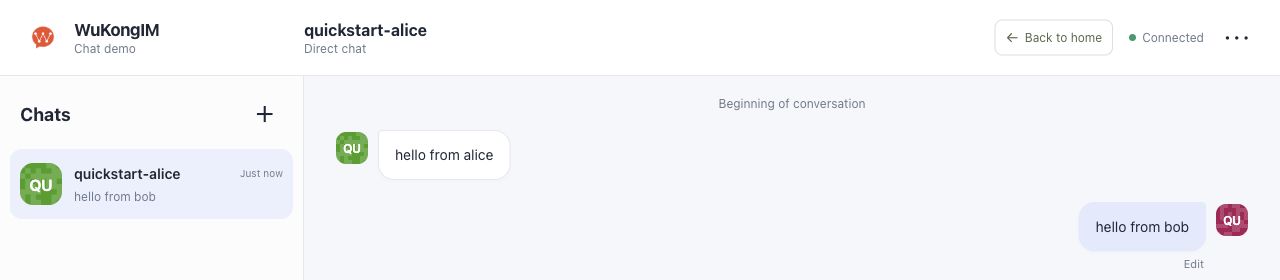
① Bob receives Alice's message. ② Bob replies. This capture verifies bidirectional exchange, without proving a peer-read receipt.
3. Handle failure and recovery
| Outcome | Action |
|---|---|
| Explicit rejection | Use Reason Codes to correct identity, permissions, or inputs |
| Timeout or unknown outcome | Retain the original identity, check the outcome, and use the SDK's supported retry method |
| Network loss or reconnect | Full SDKs sync missing persistent messages; EasySDK history and conversation recovery require product implementation |
message_id is the server-assigned identity. message_seq orders messages within one Channel, not globally. The sender generates and retains client_msg_no for correlation and retries.
Backend send: HTTP example
Only a trusted backend calls POST /message/send. Do not expose it directly to browsers or mobile clients. WuKongIM HTTP API has no general product authentication; use a private network or protected proxy. Encode payload as Base64.
curl -sS http://127.0.0.1:5001/message/send \
  -H 'Content-Type: application/json' \
  -d '{
    "from_uid": "system",
    "channel_id": "u1001",
    "channel_type": 1,
    "client_msg_no": "order-20260730-0001",
    "payload": "eyJ0eXBlIjoib3JkZXJfdXBkYXRlIiwidGV4dCI6IlNoaXBwZWQifQ=="
  }'
Example accepted-commit response:
{
  "message_id": 123456789,
  "message_seq": 42,
  "reason": 1
}
Inspect reason even with HTTP 200 and distinguish success, retries, rejection, and route changes.
Payload: versions and safe fallback
WuKongIM transports bytes; your product owns the message schema. Use a versioned envelope:
{
  "version": 1,
  "type": "order_update",
  "body": {
    "order_id": "o-10001",
    "status": "shipped"
  }
}
Ignore unknown fields and safely degrade on unknown type values. Exclude server secrets, access tokens, and unnecessary personal data.
Persistence, side effects, and NoPersist
Client connections and server HTTP share the message use case and Channel append path. After a durable commit, online delivery, conversation-related work, webhook admission/delivery, and plugin hooks can run independently. Failure does not undo the message or extend an already-completed acknowledgement.
Your backend orchestrates stronger consistency with its own database and idempotency keys. Webhooks and SENDACK are not one transaction.
Ordinary and command-style NoPersist use transient online delivery: a message ID, sequence zero, and no durable history or offline recovery. See Message Flags.
Full-SDK recovery checks
Retain Channel sync progress. After disconnection, rediscover the route, CONNECT, sync missing persistent messages, merge/deduplicate by identity and Channel sequence, and handle RECVACK correctly. Conversation-directory and Channel-message cursors are separate. See full SDKs for connection state, backoff, and sync APIs.
EasySDK does not automatically supply this history, conversation, and unread recovery. Implement it through your own backend when required.
Configure Webhooks, then complete release checks.